Table of Contents
- Key Takeaways
- Why Sloped Yards in Vancouver WA Need Real Drainage Solutions
- What Causes Poor Drainage in the Pacific Northwest
- Drainage Solutions for Sloped Yards in Vancouver WA
- Why DIY Drainage Fixes Often Fail
- Signs Your Yard Already Has a Drainage Problem
- How Drainage Ties Into Other Hardscape Projects
- When to Address Drainage Before Pacific Northwest Winters
- What a Proper Drainage Fix Looks Like
- FAQ
- Your Next Step
Standing water in the backyard after every storm isn’t random. In Vancouver, WA, it comes down to slope, soil, and where the water can go. Real drainage solutions Vancouver WA yards need go beyond one French drain.
They need to treat the whole yard as one system. This guide walks through what causes drainage failure on sloped lots here, what actually fixes it, and where DIY attempts tend to fall short.
Key Takeaways
- Drainage solutions Vancouver WA yards need account for clay soil, slope, and rainfall together.
- Standing water near a patio rarely starts at the surface. It usually starts below the grade.
- A retaining wall without proper drainage behind it can fail within a few years.
- French drains, grading, and dry wells solve different problems. The wrong one wastes money.
- DIY drainage fixes often address the symptom, not the actual water path.
- A drainage assessment before a hardscape project prevents most future failures.
Why Sloped Yards in Vancouver WA Need Real Drainage Solutions
Vancouver sits in a region with heavy winter rain and clay-heavy soil. Clay doesn’t absorb water quickly. On a sloped lot, water runs downhill and collects wherever the grade levels out.
That combination makes Vancouver different from drier parts of the country. National drainage guides rarely account for clay soil holding water for days after a storm. Local slope and soil conditions matter more here than almost anywhere else in the region.
Did you know: even a slight slope can channel hundreds of gallons of runoff toward one corner of a yard during a single storm.
One Vancouver homeowner needed real excavation work to solve this exact problem:
“The team at Dan’s Landscape did a phenomenal job through thick rain and much excavating.” — Kelli Russell, Google review
What Causes Poor Drainage in the Pacific Northwest
Poor drainage rarely comes from one issue alone. Most Vancouver yards deal with a combination of these factors:
- Clay soil that holds water instead of letting it filter through. Clay particles pack tightly, so water sits on top instead of soaking in.
- Sloped lots where water naturally pools at the low point. Without grading, that low point is often right next to the house or patio.
- Compacted soil left over from construction or old landscaping work. Heavy equipment presses soil down, closing the small gaps water needs to drain.
- Downspouts that dump water right next to the foundation. This adds a concentrated water source on top of an already saturated yard.
- Retaining walls installed without gravel or a drain pipe behind them. Water builds up behind the wall with nowhere to go.
Did you know: a single downspout dumping water at the base of a sloped yard can add more runoff to one spot than an entire afternoon of rain spread evenly across the lawn.
Drainage Solutions for Sloped Yards in Vancouver, WA
Regrading
Reshaping the slope so that water moves away from the house and patio rather than toward them. This is often the first step on any sloped lot, since every other drainage fix works better once the base grade is correct. A regrade typically involves removing topsoil, reshaping the slope, and adding new soil back in layers.
French Drains
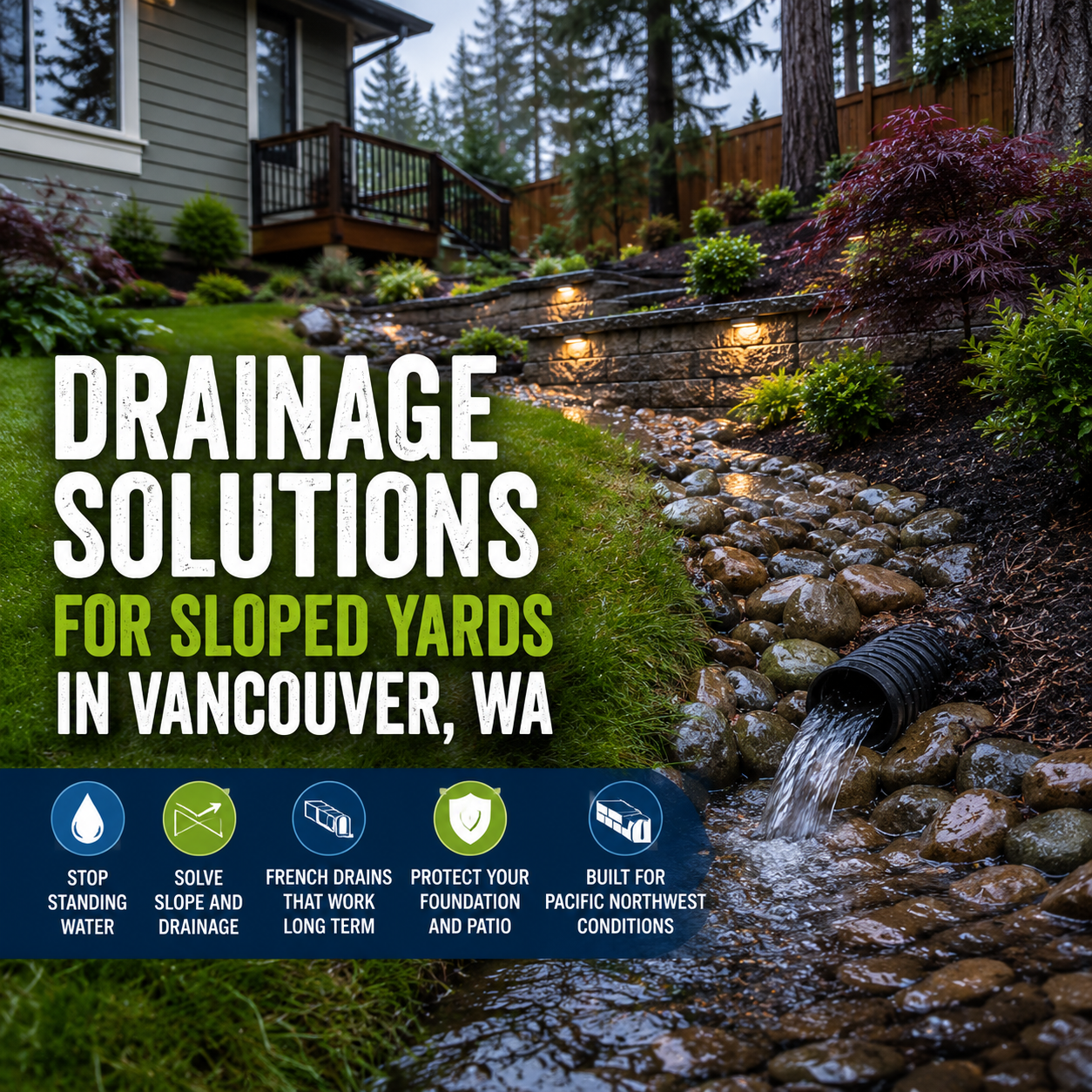
A buried, perforated pipe surrounded by gravel that redirects underground water to a safe outlet. French drains work well for wet spots that stay soggy days after rain stops. They intercept water below the surface before it reaches a foundation, patio, or walkway.
Dry Wells
An underground basin that collects runoff and gradually allows it to soak into the soil. Dry wells work best paired with a French drain, giving collected water somewhere safe to go instead of surfacing again downhill.
Retaining Walls With Proper Drainage
A wall built to hold back a slope needs gravel backfill and a drain pipe behind it. Skipping this step is the top reason retaining walls fail in this region. Water pressure builds behind an undrained wall until it bulges, cracks, or tips forward. See our guide on building effective retaining walls for what a proper installation actually includes.
Permeable Pavers
Pavers set with small gaps that let water pass through the surface rather than run off it. A strong option to pair with regrading on a patio project, especially where a solid paver base would otherwise trap water against a slope.
| Drainage Method | Best For | What It Solves |
|---|---|---|
| Regrading | Overall slope issues | Redirects surface runoff away from structures |
| French drain | Wet spots, standing water | Moves underground water to a safe outlet |
| Dry well | Concentrated heavy runoff | Absorbs water gradually into the soil |
| Retaining wall drainage | Sloped yards, retaining walls | Prevents pressure buildup behind the wall |
| Permeable pavers | Patios, walkways | Lets water pass through instead of pooling |
One Vancouver project combined several of these approaches on a steep lot:
“Transforming our sloped backyard into a beautiful usable and level yard.” — Jan McMaster, Google review
Another homeowner started with a yard that held water almost constantly:
“We had a sloped backyard that used to be a pond.” — Hayden Smead, Google review
That project involved leveling the low area, adding proper grading, and finishing with a paver patio that matched the home. The pond problem never returned.
Why DIY Drainage Fixes Often Fail
DIY drainage projects usually target the spot where water shows up, not where it originates. A homeowner sees a wet corner and digs a shallow trench there. The water often finds a new path around it within a season.
Common DIY mistakes include:
- Digging a trench too shallow to catch the actual water table
- Using the wrong gravel size, which clogs with silt over time
- Ignoring the slope of the pipe itself, so water sits instead of flowing to the outlet
- Fixing the visible wet spot while leaving compacted soil or poor grading untouched
- Skipping an outlet point entirely, so redirected water just pools somewhere else
A proper fix maps the whole path water takes across a property. That usually means grading, soil type, and outlet location all get addressed together, not one at a time.
Signs Your Yard Already Has a Drainage Problem
- Water pools in the same spot for hours after rain
- Grass stays soggy or turns to mud in one area
- A patio or walkway has started to shift or sink
- A retaining wall shows bulging, cracking, or leaning
- Water tracks toward the house foundation during storms
- A musty smell near the foundation or crawl space after wet weeks
- Moss or algae spreading across part of the lawn that never dries out
Any one of these on its own can be minor. Two or more together usually point to a grading or drainage issue that will not resolve on its own.
How Drainage Ties Into Other Hardscape Projects
Drainage rarely stands alone as a project. It shapes how every other hardscape feature performs over time.
A paver patio built without drainage planning is the most common failure point homeowners report. Water that has nowhere to go settles under the pavers, and the base shifts within a year or two.
Sprinkler systems play a role too. Overwatering a slope that already drains poorly adds to the problem instead of solving it. A well-planned residential sprinkler system accounts for slope and soil type, so irrigation supports the yard instead of overwhelming it.
Retaining walls, fences, and even lawn health all depend on water moving the right direction underground. Treating drainage as its own line item, rather than an afterthought bundled into another project, is what keeps these features working together instead of against each other.
When to Address Drainage Before Pacific Northwest Winters
Late summer and early fall are the best windows to fix drainage issues in Vancouver WA. The ground is drier, which makes excavation and grading easier and more accurate.
Waiting until winter rains start makes problems harder to diagnose. Standing water hides the underlying grade issue, and soft, saturated soil is harder to work with safely. Addressing drainage before the wet season also protects any hardscape project completed earlier in the year, since a new patio or retaining wall installed without a full rainy season behind it can still reveal drainage gaps once winter arrives.
What a Proper Drainage Fix Looks Like
A proper fix starts with an assessment, not a guess. Real hardscaping services in Vancouver WA should map out grade, soil type, and water flow before any digging starts.
Fixing one wet spot without addressing the source usually means the problem returns. Full landscape design and installation planning accounts for drainage from the very first sketch.
Some yards have a slope steep enough to need structural support. Then drainage becomes part of a larger retaining wall project. See our retaining wall installation in Battle Ground page for an example of grading and drainage working together.
FAQ
How do I know if my yard needs a French drain or a dry well?
A French drain works when water needs to be directed away from an area, such as a foundation. A dry well works better for a single low spot collecting heavy runoff.
Can I fix yard drainage without hardscaping?
Sometimes. Regrading alone solves surface-level pooling. Once a patio or retaining wall is involved, drainage needs to be part of that project from the start.
Why does my retaining wall keep leaning or cracking?
This usually means there is no gravel backfill or drain pipe behind the wall. Water pressure builds up over time and pushes the wall forward.
How much slope is too much for a standard patio installation?
Any noticeable slope needs grading or a tiered design before installation. Ignoring it leads to pavers settling unevenly within the first year.
Does clay soil always mean drainage problems?
Not always, but it raises the odds. Clay holds water longer than sandy soil, so drainage planning matters more on clay-heavy lots.
Will fixing drainage damage my existing lawn or landscaping?
Some disruption is normal near the work area. A well-planned project limits digging to the actual drainage path and restores sod or plantings once work wraps up.
How long does a typical drainage fix take?
Smaller fixes, like a single French drain, often take a day or two to finish. Larger regrading or retaining wall projects with drainage work take longer, depending on the slope and scope.
Your Next Step
Standing water and sinking pavers are almost always fixable once the real cause gets addressed. Guessing at a fix usually means paying for it twice.
If your yard holds water after every storm, request a free estimate and get an honest look at what’s happening below the surface.